Chocolate & Sugar
Panning builds a sugar shell one thin layer at a time
The hard coating on a sugared almond is neither moulded nor dipped; it is grown inside a rotating drum by alternating small doses of syrup with drying air until the shell is thick enough.
By Faisal Ahmed4 min read
A coating that is grown rather than applied
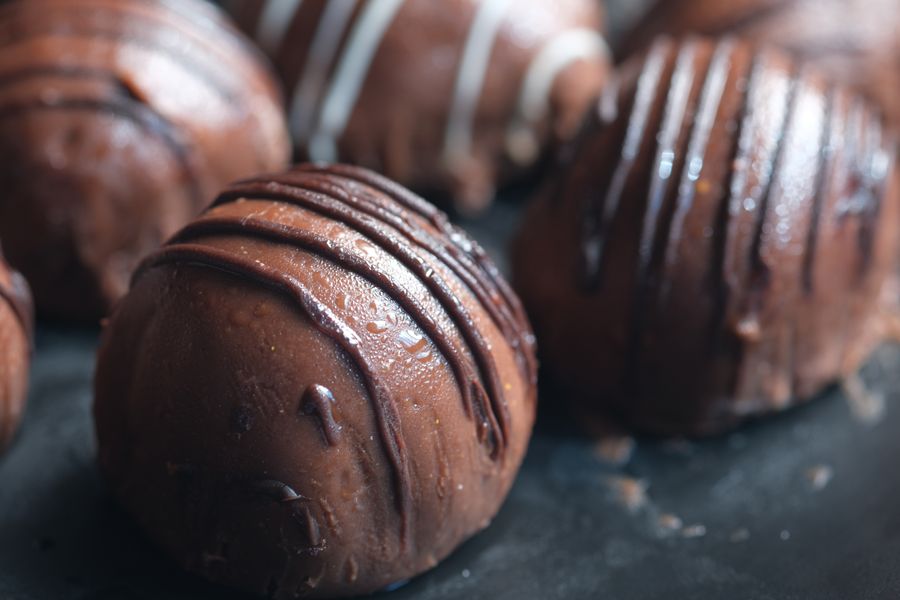
A sugared almond has a shell of a millimetre or two that is smooth, opaque and hard, and it is fair to wonder how it got there. Dipping would give a coating that ran and pooled. Moulding would need a mould for every centre. The answer used in practice is neither: the centres are tumbled in a rotating drum while syrup is added in small doses, and each dose is dried before the next arrives, so the shell accumulates in dozens of thin layers.
The rotation is what makes it work. Continual tumbling distributes each dose evenly across every centre and keeps the pieces separated while they are tacky, and the drying air removes water from the syrup so that what remains is solid sugar. Get the balance wrong in one direction and the pieces stick together into clusters; wrong in the other and the syrup dries before it has spread, giving a rough, chalky surface.
Hard panning is a crystallisation process with a drying step
In hard panning the syrup is a concentrated sucrose solution. As the water is driven off by warm air, the sucrose is left supersaturated and crystallises, and it crystallises onto the surface already present rather than forming separate grains. Every dose therefore adds a thin crystalline layer bonded to the one below it, and the shell that results is a stack of them, which is why a cracked dragee shows a structure rather than a uniform mass.
The size of those crystals decides the quality of the surface, and it is controlled by how fast the water is removed. Slow, gentle drying gives small crystals and a smooth, dense shell that takes a polish. Fast drying gives coarse crystals and a shell that looks dull and feels rough. This is the same trade between nucleation and growth that governs any sugar work, applied to a surface instead of a mass.
Soft panning keeps the syrup from crystallising at all
Not every coating is meant to be hard. In soft panning the syrup contains enough glucose syrup or invert sugar to prevent orderly crystallisation, so each layer dries to a chewy or slightly plastic film rather than a crystalline one. Fruit-flavoured chewy shells are built this way, and so are many coatings where a brittle crack isn’t wanted.
Chocolate lentils are a third case, and they are engrossed rather than panned in the sugar sense. Molten chocolate is applied to the centres in a cooled drum, and each application is set by cold air rather than dried, building up a chocolate layer before a thin sugar shell goes on over the top. The drum has to be kept cool throughout, since chocolate that is allowed to warm will smear rather than set, and the temper has to survive the process.
The centre has to be sealed before anything else can happen
A nut is the classic centre and it is also the problem, because a nut is full of oil and oil migrates. Left alone, that oil moves outward into a sugar shell, softens it, discolours it and eventually breaks it. So the first stage of panning a nut isn’t sugar at all: it is a sealing coat, traditionally gum arabic, sometimes with a little starch or shellac, applied and dried to give a barrier between the fat inside and the sugar outside.
The same logic applies to any centre that carries moisture or fat. A soft fruit centre would give up water into the shell and dissolve it from within; a chocolate centre would bleed cocoa butter. Gum arabic also acts as a binder that helps the first sugar layers adhere to a smooth surface, which is a second reason it appears at the start of nearly every recipe in this trade.
Colour, polish and why the process cannot be hurried
Colour is applied in the final layers rather than throughout, because pigment in the bulk of the shell is wasted and because a coloured surface layer gives a cleaner result. Polishing follows, usually with carnauba wax, beeswax or a shellac-based confectioner glaze applied in a separate drum, and it does two things: it produces the gloss and it seals the shell against atmospheric moisture, which a bare sugar surface would readily absorb.
The whole sequence takes hours and in some cases days, and the limiting factor is drying rather than coating. Each layer has to lose its water before the next can be added, and pushing the air hotter or faster to speed this up coarsens the crystals and ruins the surface. It is one of the clearest examples in confectionery of a process whose duration is set by physics rather than by tradition, and it is why the finish on a good dragee is difficult to reproduce domestically.
Common questions
Why are panned sweets always rounded?
Because tumbling favours it. Corners and edges receive more contact and therefore more coating than recessed areas, so every layer smooths the shape a little further. An irregular centre gradually becomes a regular one, which is a useful property when the centres are nuts and no two are alike.
Can panning be done in a home kitchen?
On a small scale, with patience and a bowl or a small rotating drum, up to a point. The hard part isn’t the syrup but the air: controlling drying rate is what determines crystal size and therefore surface quality, and a kitchen offers very little control over that. Expect a rougher shell.
What is the glaze listed on a packet of dragees?
Usually a wax or a shellac-based confectioner glaze applied at the end of the process. It provides the shine and, more usefully, seals the sugar shell against humidity. Without it the surface dulls quickly and becomes tacky in a damp room, since sugar readily takes up water from the air.
Consumer editor, The Last Bite
Faisal writes the explanatory pieces on baking basics, chocolate & sugar, frozen and is happiest when a piece answers the question completely.