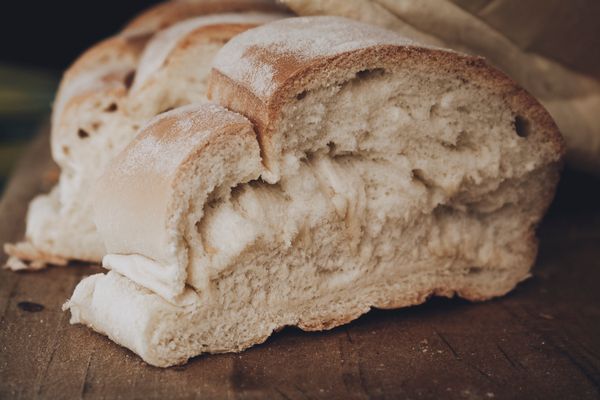
Baking Basics
The first ten minutes in the oven decide the shape of a loaf
Oven spring is a brief window in which gas expands faster than the structure can set, and everything you do to a loaf beforehand is preparation for it.
By Sanaya Dastur4 min read
A dough is never so alive as in the first few minutes of heat
A loaf put into a hot oven does not begin gently. Within a minute or two the outer centimetre is climbing through temperatures the dough has never seen, and several things start happening at once, all of them pushing outwards. This is oven spring, and in a well-managed loaf it accounts for a substantial part of the final volume. It is also brief. By the time the crumb has reached the temperature at which starch sets, the shape is fixed and nothing further can be negotiated.
Understanding the sequence is what makes the standard advice about slashing, steam and preheating stop sounding like ritual. Each of those practices is an intervention at a particular moment in a chain of events that takes under a quarter of an hour, and knowing which moment each one addresses tells you immediately which of them will fix the problem in front of you.
Three separate expansions arrive together
The first is simple physics: gas already trapped in the dough expands as it warms, because a fixed quantity of gas occupies more volume at a higher temperature. Every bubble that fermentation created gets larger without any new gas being produced at all.
The second is dissolved carbon dioxide coming out of solution. A proofed dough holds a good deal of gas dissolved in its water phase, and gases become less soluble as temperature rises, so it leaves the liquid and joins the existing bubbles. The third is vaporisation. Water turns to steam and ethanol produced during fermentation boils off at a lower temperature still, and both of them expand enormously as they change phase. Steam is the largest contributor in most loaves.
Yeast contributes a final burst too, working rapidly in the warmth before it is killed somewhere around 55 to 60°C. It is the smallest of the four effects and the one most often given credit for the others.
Then the structure sets and the window closes
Between roughly 60 and 85°C, two changes convert an expanding elastic dough into a fixed crumb. Starch granules absorb water and swell, gelatinising into a soft gel, and gluten proteins coagulate and give up water as they do. The dough stops behaving like a stretchable material and starts behaving like a solid foam. Everything after that point is drying and browning rather than shaping.
This is why oven temperature matters so much for shape rather than merely for time. Too cool an oven sets the structure slowly but also lets gas escape gradually rather than driving it outwards, and the loaf never gets its push. Too hot and the crust hardens before the interior has finished expanding, which forces the loaf to burst wherever the surface is weakest.
Steam keeps the surface negotiable
A humid oven at the start does something quite specific. Moisture condenses on the cool surface of the loaf, keeping that surface soft and extensible for several minutes longer than it would otherwise remain, so the dough can expand without tearing. It also gelatinises starch at the surface, and when that layer later dries in the second half of the bake it becomes the thin glassy crust that shines and crackles as it cools.
Without steam the crust sets early and hard, the loaf is contained before it has finished growing, and the surface tends to rip in whatever direction it can. Domestic ovens vent, so whatever steam you add leaves quickly; baking under a heavy covered pot works because it traps the loaf’s own moisture around it, which is generally more effective than water thrown into a large vented cavity.
Scoring is direction, not decoration
A loaf under oven spring is going to open somewhere. A cut made just before baking gives it a deliberate weak point, so the expansion is directed rather than random, and the flap of dough that lifts along the cut — the ear — is the visible record of a loaf that expanded before it set. Cuts made too shallow, or into a dough that is over-proofed and has no push left, produce nothing.
The depth of the cut is what makes the difference, and it is usually a matter of angle rather than force. A shallow slash held nearly parallel to the surface lifts a flap; a vertical stab of the same depth simply opens and closes again as the loaf swells. Bakers argue endlessly about blade type and pattern, and much of that is aesthetic, but the underlying requirement is not.
And the unglamorous factor: a properly preheated stone or steel matters more than most of the rest. Heat delivered into the base of a loaf drives the steam upwards through the crumb and gives the underside enough energy to expand at the same rate as the top. A cold tray delays that, and a loaf that starts on cold metal often looks fine on top and dense at the bottom.
Common questions
Can I open the oven during a bake?
For bread, not in the first ten minutes or so, since you lose both heat and humidity precisely when the loaf needs them. Later in the bake, when the structure has set, a quick look costs very little. Cakes are less tolerant because their walls set more slowly.
Why did my loaf spread instead of rising?
Usually over-proofing. A dough left to ferment too long has a network weakened by enzyme activity and bubbles that have already merged into large unstable cells, so heat makes it slump rather than push. Under-developed gluten and too-slack shaping give a similar result by a different route.
Does adding water to a tray in the oven work?
It helps a little and it is worth doing if you have nothing else, but a domestic oven vents most of that humidity within a couple of minutes. Baking inside a covered vessel traps the moisture the dough itself gives off, which is a far more reliable way to keep the surface soft.
Features writer, The Last Bite
Sanaya writes the explanatory pieces on baking basics, chocolate & sugar, frozen and would rather show the working than assert the conclusion.