Baking Basics
Crumb structure is decided by how much gluten you let form
Flour does not contain gluten. It contains the two proteins that make it, and every texture decision in baking is a decision about how much of that network to allow.
By Sanaya Dastur4 min read
Flour arrives as a kit rather than as an ingredient
There is no gluten in a bag of flour. What is in there are two storage proteins, glutenin and gliadin, sitting inert in the endosperm of a milled wheat grain, and they only become gluten when water reaches them and something moves them around. Add water and they hydrate. Apply mechanical work and they begin to link into a continuous elastic network that runs through the entire dough — the same network that lets a bread dough be stretched thin enough to see light through it, and that turns a mishandled cake batter rubbery.
The two proteins contribute different properties, and the balance between them matters rather more than the total quantity. Glutenin supplies elasticity, the springing back you feel when a dough resists being pulled. Gliadin supplies extensibility, the willingness to stretch without tearing. A dough with enough of both can hold fermentation gas for hours. A dough short of either fails in a way you can diagnose with your hands: too much spring and it fights you at the shaping stage, too little and it slumps into a puddle.
Mixing decides the size and alignment of the network
Kneading does two jobs simultaneously. It brings protein chains into contact so bonds can form between them, and it stretches and folds those chains so the bonds end up aligned in sheets rather than knotted at random. Part of the linkage is chemical, sulphur atoms in the protein pairing into disulphide bridges that survive further handling. Part of it is nothing more than physical entanglement, long molecules threaded through one another. Both get stronger the longer the dough is worked.
Time does a surprising amount of this on its own, which is why a dough that is never kneaded can still end up behaving like one that was. Left sitting in water, the proteins find each other; enzymes already present in the flour go on modifying the network while it rests. That is the mechanism behind an autolyse, the pause between mixing flour with water and adding anything else. How much difference it makes in a domestic kitchen is genuinely disputed among bakers, and the honest answer is that it depends on the flour, the hydration and how long you were going to mix anyway.
A cake is a bake in which you are working to prevent all this
Everything above describes what bread wants and what a cake wants much less of. Cake flour is milled from softer wheat with a lower protein content, so there is simply less raw material for a network to form from. But the recipe is doing suppression work too, and the two agents responsible are fat and sugar.
Fat coats flour particles and physically interposes itself between the proteins, so any network that does form is short and interrupted rather than continuous — the same principle that gives shortcrust its name. Sugar interferes by a different route. It is hygroscopic, so it holds on to water the proteins would otherwise have used, and hydration that never happens is a network that never develops. This is a large part of why a sweet enriched dough takes noticeably longer to come together than a lean one.
So the instruction to fold gently until barely combined is not fussiness. Every additional turn of the spoon builds structure you have specifically decided you do not want.
Gas needs a wall, and gluten is only one candidate
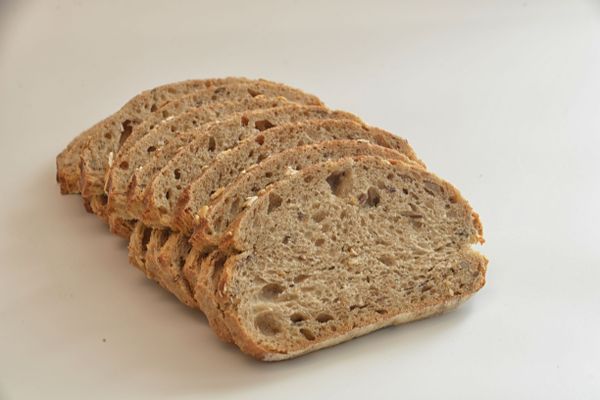
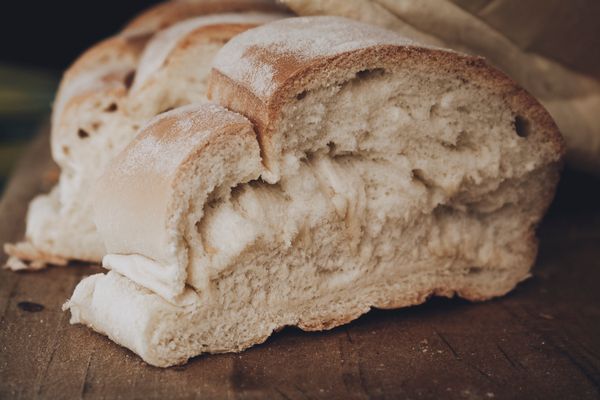
Leavening produces gas, but gas escapes unless something holds it in place. In bread the gluten network is that wall: it forms thin elastic films around each bubble, stretches as they expand, and holds until oven heat sets the starch and coagulates the protein into something permanent. The open crumb of a good loaf is a record of where the bubbles happened to be at the moment the walls stopped moving.
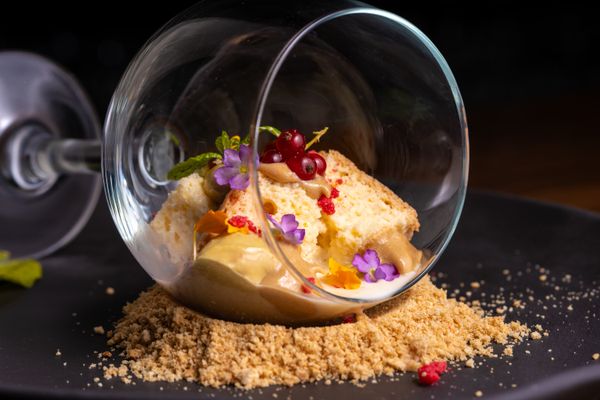
In cakes the wall is built out of other materials entirely. Egg proteins coagulate, starch granules absorb water and swell into a gel, and an emulsion of fat, sugar and air holds the bubbles in suspension until that setting happens. A cake crumb is finer and more even because the bubbles were beaten in rather than grown by fermentation, and because there is no elastic net allowing them to merge into large irregular holes.
The failures are diagnostic if you read them
Tunnels in a muffin — those long vertical channels running up through the crumb — are a gluten problem announcing itself. The batter was mixed enough to build a continuous network, gas then pushed through that network along paths of least resistance instead of staying in discrete cells, and the result is chewy and tough with holes in the wrong shape. Nothing fixes it afterwards.
Bread failures run in the opposite direction. A loaf that spreads outwards instead of rising usually has a network too weak or too degraded to hold gas: under-developed, over-proofed, or made from flour that never had the protein for the job. A dough that tears when you try to shape it has the opposite problem, over-developed and short of extensibility, and it will generally relax if you cover it and walk away for a quarter of an hour.
Which is the useful summary. Gluten is not good or bad. It is a variable, and it is the one that most reliably explains why a bake came out the way it did.
Common questions
Can I make bread with low-protein flour?
You can, and plenty of traditional breads are made from soft wheat. Expect a tighter, more tender crumb and less rise, because there is less protein available to build the network that holds gas. Handling matters more, not less — a weaker dough punishes rough shaping.
Does resting a dough replace kneading?
Largely, given enough time and enough water. Hydrated proteins link up without mechanical help; a wet dough left for hours with a few gentle folds develops a perfectly good network. What you cannot do is skip both the work and the time and expect structure to appear.
Why is my cake tough when I followed the recipe?
Overmixing after the flour went in is the usual cause, particularly with a stand mixer where thirty extra seconds is easy to give away. Cold eggs that split the batter are a secondary suspect, since a broken emulsion tempts you into mixing more to bring it back.
Features writer, The Last Bite
Sanaya writes the explanatory pieces on baking basics, chocolate & sugar, frozen and would rather show the working than assert the conclusion.