Chocolate & Sugar
Bloom is chocolate rearranging itself rather than going off
The grey film on old chocolate has two quite different causes, and neither of them means the bar has spoiled.
By Amrita Kohli4 min read
Two failures that look alike
A bar left too long, or stored badly, develops a pale streaked film on its surface and loses its snap. This is bloom, and the immediate thing worth saying is that it is not mould, not rancidity and not a safety problem. It is a physical rearrangement of one of the ingredients, and the chocolate is still chocolate. What it is not is good chocolate — the texture is compromised and so is the gloss.
There are two distinct varieties with two distinct causes, and telling them apart tells you what went wrong in storage. Fat bloom comes from cocoa butter migrating and recrystallising at the surface. Sugar bloom comes from moisture dissolving sugar at the surface and leaving crystals behind when it evaporates. They can look similar at a glance and they feel entirely different under a finger.
Fat bloom is the crystal problem catching up with you
Cocoa butter is polymorphic, and the form that gives tempered chocolate its snap and shine is not the most stable one available. Over time, and much faster when the chocolate is warmed and cooled repeatedly, the fat gradually converts towards form VI, which is more stable, melts a degree or two higher, and forms coarse crystals that grow out to the surface. The result is a whitish or greyish veil and a texture that has gone slightly crumbly and dull.
Temperature cycling accelerates this dramatically because partial melting frees fat to move. A bar that spends its afternoons in a warm room and its evenings in a cool one has liquid cocoa butter migrating through it every single day, and each cycle deposits a little more at the surface. Chocolate that was never properly tempered blooms sooner, since it started out in a less stable arrangement and has less distance to travel.
Sugar bloom comes from water and looks the same from a distance
Chocolate is a suspension of sugar and cocoa solids in fat, and it contains almost no water. Expose the surface to moisture — condensation from a fridge, a humid kitchen, a hand — and that moisture dissolves some of the sugar sitting at the surface. When the water evaporates the sugar recrystallises in larger, irregular crystals, producing a grey film that is gritty rather than greasy.
This is the reason refrigerating chocolate is bad advice unless it is wrapped properly and unwrapped only after it has come back to room temperature. Cold chocolate taken into a warm kitchen collects condensation immediately, in the same way a cold glass does. Fat bloom feels slick and softens under a warm thumb; sugar bloom stays gritty and does not. That is the simplest way to tell which mistake was made.
What can and cannot be undone
Fat bloom is reversible in the sense that melting and re-tempering the chocolate destroys every crystal and starts again. The bar itself is finished, but the material is fine and works perfectly well in a ganache, a bake or anything where it will be melted anyway. Nothing has been lost except appearance and the arrangement of the fat.
Sugar bloom is less tractable. The sugar crystals will dissolve back in if water is present, but re-melting bloomed chocolate that has taken on moisture risks seizing, and the surface roughness usually indicates a bar that has been through humidity that also dulled its flavour. Neither type is harmful. Both are a decent argument for buying chocolate in quantities you will use.
Storage is mostly about stability, not coldness
The conditions that prevent bloom are unglamorous: a steady temperature somewhere around 15 to 18°C, low humidity, no light, and no strong smells nearby, because cocoa butter absorbs odours readily. Stability matters more than the exact figure. A cupboard that sits at a constant 20°C is better for chocolate than a fridge it goes in and out of.
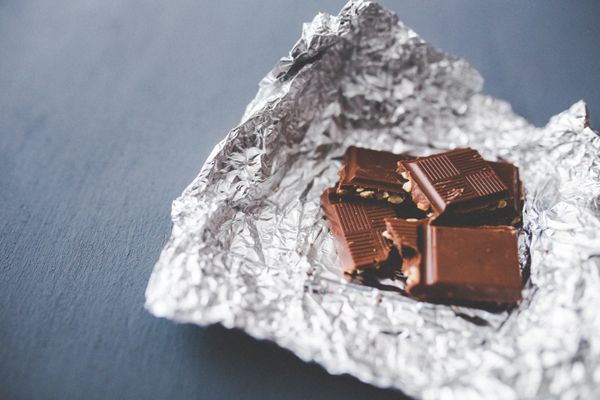
Wrapping matters for the same reason. Chocolate is usually sold in foil rather than clear film because foil excludes light and slows the exchange of moisture and smells, and once a bar is opened, folding the foil back over the cut face does more good than dropping the whole thing into a plastic box with the coffee. Cocoa butter takes up aromas from the air readily and does not give them up.
If a warm climate leaves no choice, the fridge works provided the chocolate is sealed against moisture and allowed to reach room temperature before it is opened. That single habit prevents most sugar bloom. And it is worth accepting a certain amount of this as normal: filled chocolates and bars with nut pastes bloom faster because other fats migrate into the cocoa butter and disturb its crystal structure, which is a consequence of what they are rather than a defect in how they were made.
Common questions
Is bloomed chocolate safe to eat?
Yes. Bloom is a physical change in the fat or the sugar, not spoilage, and there is no microbiological issue — chocolate has too little water to support much growth. The texture and shine are diminished, and old chocolate can taste flat, but that is a quality question rather than a safety one.
Can I fix a bloomed bar?
You can melt and re-temper it, which fully resolves fat bloom, though you cannot restore it to a smooth moulded bar without moulding it again. In practice the sensible use is anywhere it gets melted anyway: ganache, brownies, a sauce. Sugar-bloomed chocolate is more likely to misbehave when melted.
Why does chocolate in a shop window bloom so fast?
Sunlight and daily temperature swings. Every warm afternoon partially melts some of the cocoa butter and every cool night recrystallises it at the surface, and after a few cycles the effect is visible. It is one reason serious chocolate is usually kept out of direct light.
Senior writer, The Last Bite
Amrita has written about baking basics, chocolate & sugar, frozen for most of the last decade and is unreasonably interested in the detail nobody else checks.