Chocolate & Sugar
A filled chocolate spoils because of the water in its centre
The shell keeps almost indefinitely and the filling inside it does not, and the difference comes down to how much of the water in that filling is free to support anything living.
By Sanaya Dastur4 min read

The shell has almost nothing to spoil
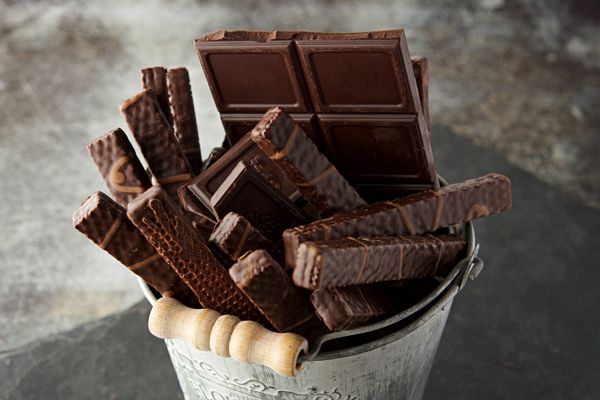
Plain chocolate is close to inert as foods go. It is fat, sugar and finely ground solids with very little water, and microorganisms cannot grow without water, so a sealed bar deteriorates through fat migration, crystal change and the absorption of odours rather than through spoilage. That is the reason chocolate carries a best-before date rather than a use-by date, and why an old bar is usually unappealing rather than unsafe.
Put a soft centre inside it and the arithmetic changes entirely. A ganache contains cream, a fruit filling contains juice, and both introduce water into a system that had none. Almost every question about how long a filled chocolate lasts is therefore a question about that centre, and the shell is relevant mainly as a barrier — a good one against oxygen and a poor one against determined moisture.
Water activity isn’t the same as water content
The measurement that matters is not how much water is present but how much of it is available. Water bound to sugar, to glycerol or to dissolved solids is not free to act as a solvent, and organisms need free water. Food scientists express this as water activity, a figure between zero and one which compares the vapour pressure above the food to that above pure water, and it predicts spoilage far better than moisture content does.
The thresholds are well established and usefully simple. Most bacteria of concern require conditions close to those of fresh food and stop well before a confection gets dry. Most moulds need less, and osmophilic yeasts — the ones adapted to sugary environments — can carry on lower still, which is why the failure in a sweet filling is far more often a yeast than anything else. A centre pushed below the point where those yeasts function is stable at room temperature, and one that sits above it is not, however much sugar it contains.
Sugar, glucose and alcohol all pull the figure down
Lowering water activity means dissolving more particles in the available water, and what matters is the number of dissolved molecules rather than their weight. This is why invert sugar and glucose syrup are more effective than an equal mass of sucrose: sucrose splits into two smaller molecules when inverted, so the same weight supplies roughly twice the particles. Sorbitol and glycerol are used for the same reason, and they hold the centre soft as a bonus.
Alcohol works differently and works well. Ethanol lowers water activity, and it is also directly hostile to the organisms in question, which is why liqueur centres and alcohol-soaked fruit have long been the traditional way of keeping a soft filling stable. Acidity is a third lever, though a mild one, and it interacts with everything else — a filling that is safe at one combination of sugar, acid and alcohol may not be at another.
The other failures are physical rather than microbial
Long before anything grows, a filling can fail on its own terms. A ganache is an emulsion of fat in a sugar and water phase, and emulsions separate; a centre that has broken shows as an oily film against the shell and a grainy texture behind it. Temperature swings are the usual trigger, since fat expanding and contracting stresses the emulsion, and so is a ratio that never had enough emulsifier for the fat it was asked to carry.
Sugar crystallising in the centre is the second physical failure, and it is why a well-made ganache normally contains glucose or invert sugar even when shelf life is not in question. The third is syneresis, where a set filling contracts and squeezes out liquid, which then sits between the filling and the shell and eventually finds a way through it. None of these makes a chocolate unsafe. All of them make it unsellable.
The shell has to be sealed as well as glossy
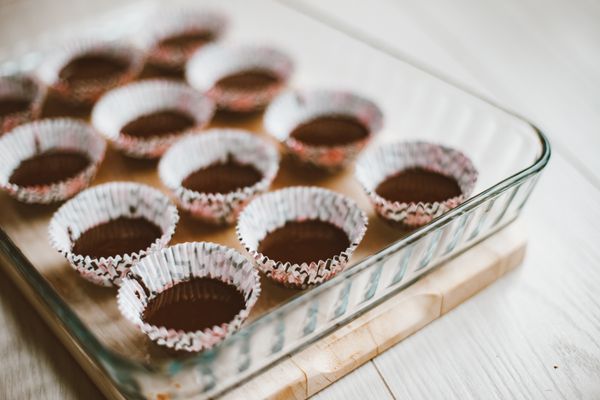
A moulded shell fails at its base, which is the last part to be closed and the part where a thin patch or a trapped air bubble is easiest to miss. Any opening lets the centre exchange moisture with the room, and it lets air reach a filling with fat in it. Hand-dipped centres have the same weakness at the foot, which is a large part of why dipping technique concentrates on getting a continuous coating right around the base.
A well-tempered shell also contracts slightly as it sets, which helps it release from the mould and helps it fit the centre closely. A poorly tempered one is softer, more porous and less protective, so temper is a shelf-life question and not only a cosmetic one. Given all this, a stated shelf life is a claim about a specific recipe made in specific conditions, and it doesn’t transfer between kitchens. A fresh cream ganache made at home is a few days in a cool place, and treating it as anything more is optimistic.
Common questions
How long does a home-made ganache truffle keep?
Days rather than weeks, if it is made with fresh cream and nothing added to bind the water. Refrigeration extends it but risks condensation on the surface when the chocolate comes back out, which causes sugar bloom. Glucose, invert sugar or a little alcohol in the recipe genuinely extends the window.
Does refrigerating filled chocolates help or hurt?
It slows both microbial and chemical change, and it introduces a condensation problem every time the box comes out of the fridge. If you do refrigerate, bring the whole sealed container back to room temperature before opening it, so the moisture condenses on the packaging rather than on the sweets.
Why do commercial fillings last so much longer?
They are formulated to. Higher dissolved solids, glucose syrup or invert sugar rather than plain sucrose, sometimes humectants or alcohol, and a sealed shell made under controlled conditions. The result is a centre in which very little of the water is free, which is a different product from a fresh cream ganache rather than the same one kept better.
Features writer, The Last Bite
Sanaya writes the explanatory pieces on baking basics, chocolate & sugar, frozen and would rather show the working than assert the conclusion.