Pastry
Puff, rough puff and flaky are three distributions of one fat
The ingredients barely differ between them, and the whole distinction lies in how the butter is arranged before the rolling starts.
By Aditya Ramaswamy4 min read

Almost the same list, three different pastries
Flour, butter, water, salt. Written down, classic puff pastry, rough puff and a flaky pastry look close to identical, and the proportions differ less than the names suggest. What differs is geometry — whether the fat starts as one continuous block, as scattered lumps, or as pieces distributed through a dough — and that geometry decides the structure of the finished thing more completely than any ingredient could.
It is a useful family to understand together, because the same physics runs through all of them. Fat separates sheets of dough; water turns to steam; steam pushes the sheets apart; heat sets them before they can fall back. The three pastries differ only in how regular that separation is.
Classic puff builds an ordered stack
In the traditional method a block of butter is enclosed in a sheet of dough and the two are rolled and folded together repeatedly. Because the butter starts as one continuous piece, every fold divides it cleanly, and the layers stay parallel and even. After a conventional sequence of turns the result is several hundred alternating layers of dough and fat, all running horizontally.
That order is what produces the characteristic rise: a puff pastry lifts straight up, evenly, to many times its raw thickness, and the cut edge shows a regular striped structure. It is also what makes the pastry demanding. Any break in the butter sheet becomes a fused patch that will not lift, so the rolling has to be even, the temperature controlled, and the edges kept square — the corners are where the butter runs out first.
Rough puff scatters the fat and accepts the consequences
Rough puff starts differently. Cubes of cold butter are mixed into the flour and water without being fully worked in, and the resulting shaggy dough is rolled and folded in the usual way. The butter is flattened into irregular streaks and patches rather than continuous sheets, so the layering is real but uneven, and the pastry rises well without rising uniformly.
For a great many applications that is the better outcome, or at least an entirely acceptable one. A pie lid, a sausage roll, a turnover, a tarte fine — none of them requires geometric regularity, and the rough method takes a fraction of the time and tolerates a warmer kitchen because there is no single butter sheet to tear. What it will not do is give the tall, even, architectural lift that a mille-feuille depends on.
Flaky pastry sits between rubbing and lamination
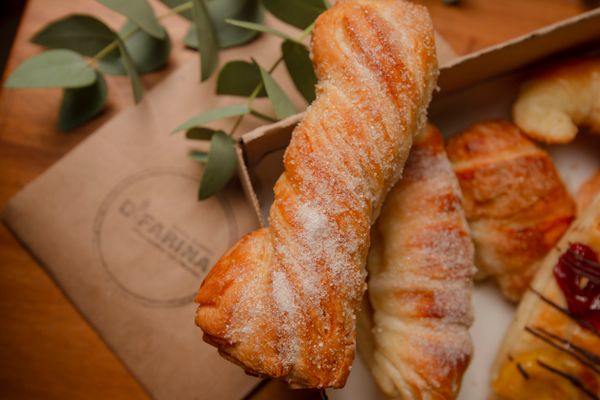
The older English flaky pastry takes a third route: part of the fat is rubbed into the flour as for a shortcrust, and the rest is dotted over the rolled dough in small pieces before folding, often across two or three rollings. The rubbed portion tenderises by interrupting gluten; the dotted portion melts and leaves voids that steam expands.
The result is a pastry that is both short and layered, flaking in irregular sheets rather than lifting cleanly. It was designed for a domestic kitchen without refrigeration and it shows sensible priorities — it is quicker than puff, more forgiving than either, and it produces something that suits a pie better than a strictly laminated dough would. The vocabulary here is genuinely inconsistent between countries and between older and newer books, and it is worth reading a recipe’s method rather than trusting its title.
Choosing between them honestly
The temptation is to treat classic puff as the correct version and the others as compromises, and that is not quite right. Each is matched to a job. Where the layers themselves are the point — a vol-au-vent that must rise straight, a mille-feuille whose cut face is on display — the ordered method earns its extra hours. Where the pastry is a container or a lid, the irregular ones perform at least as well and sometimes better, since a rougher texture holds sauce and looks handmade.
There is a middle route worth knowing about as well, sometimes called the blitz or Scotch method, in which large slabs of butter are tossed with flour and water and then laminated with several turns. It sits between rough puff and the classic in both effort and evenness, and in a domestic kitchen it often produces the best return for the time spent. Whether it counts as a genuine puff pastry is the kind of argument pastry cooks enjoy and nobody settles.
One thing applies to all three. They must go into a hot oven and stay in long enough to dry out. Steam-leavened pastry that is pulled early collapses as it cools, because the layers were pushed apart but never set, and the interior is left damp and greasy rather than crisp. That failure looks like a lamination problem and is usually just an oven that was too cool or a bake that was too short.
Common questions
Is bought puff pastry a reasonable substitute?
For most purposes, yes, and the main variable is whether it is made with butter or another fat. Butter versions taste better and behave much like homemade. The block form generally gives a better rise than pre-rolled sheets, which have already been stretched and sometimes handled while warm.
Why does my puff pastry rise unevenly?
Uneven rolling is the usual cause, followed by a blunt cut. A crushed edge seals the layers together and stops them lifting, so cut with a sharp knife straight down rather than dragging. Rolling in one direction each time, and turning the dough between turns, keeps the layers more even.
Can I freeze laminated dough?
Yes, and it freezes well because the structure is physical rather than biological. Freeze it after the final turn and thaw it in the refrigerator so the butter never passes out of its working range. Yeasted laminated doughs are more sensitive, since freezing damages some of the yeast.
Contributing editor, The Last Bite
Aditya has written about baking basics, chocolate & sugar, frozen for most of the last decade and prefers a plain explanation to a clever one.